
Last Updated on April 16, 2026 by administrator
A kitchen countertop has to do more than look nice. It handles heat, splashes, acidic food residue, heavy pots, daily cleaning, and the occasional dropped utensil. If I had to pick one surface in the kitchen that earns its specification more than any other, it would be the countertop.
Some materials look impressive in a kitchen showroom in Cheras or Kepong and become frustrating to live with within eighteen months. Others seem plain by comparison but perform reliably for ten to fifteen years with minimal fuss. The best countertop for a Malaysian kitchen is the one that suits how the kitchen is actually used, how willing the household is to follow maintenance requirements, and what the renovation budget realistically supports.
The Malaysian Kitchen Context That Changes Everything
Malaysian kitchen countertops face conditions that countertop guides written for temperate climates do not fully account for. Wok cooking generates high heat on and around the cooking area. Splashes from curries, sambal, and oil-based cooking are more aggressive staining agents than the sauces common in western cooking. Cleaning agents used in Malaysian kitchens, particularly for degreasing, are often more alkaline or more acidic than the gentle cleaners most countertop manufacturers test against.
Add to this the year-round humidity that affects adhesives, silicone joints, and the substrate materials under the countertop, and the picture of a Malaysian kitchen’s demands becomes clearer. A countertop material that performs adequately in a European test kitchen may degrade noticeably faster in Malaysian conditions. Understanding this going in produces better material decisions than simply following international kitchen design trends.
Quartz: Why It Became the Default in Malaysian Kitchens
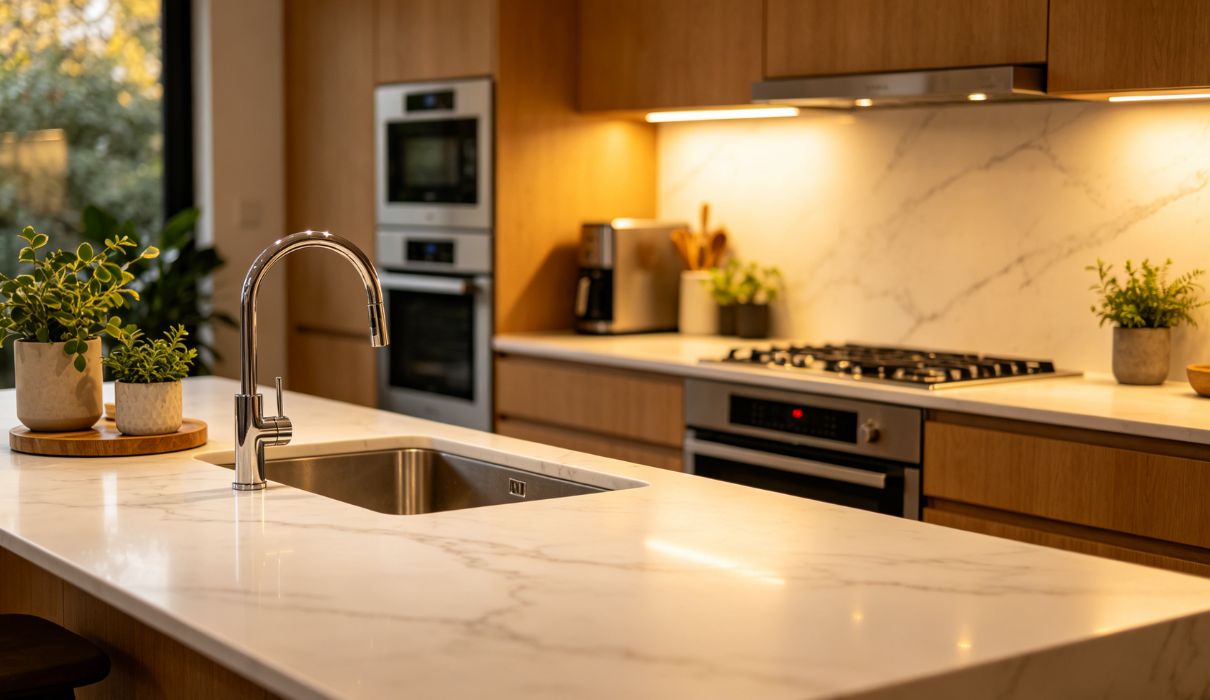
Quartz engineered stone has become the dominant countertop choice in Klang Valley residential renovation over the past decade, and there are real reasons for this beyond trend-following. Quartz is a factory-engineered product combining ground quartz crystals with polymer resins and pigments. Because the composition is controlled, the surface is consistent in colour, hardness, and porosity in a way that natural stone is not.
Non-porosity is the practical advantage that matters most in Malaysian conditions. A non-porous surface does not absorb liquids, which means curry stains, coffee rings, and oil residue sit on the surface rather than penetrating it. They clean off with a damp cloth rather than requiring special treatments. For families cooking Malaysian food daily, this cleaning simplicity is genuinely valuable.
Quartz countertop pricing in Malaysia depends primarily on whether the product is locally distributed or imported. Local distribution of brands like Silestone, Caesarstone, Compac, and regional alternatives runs RM150 to RM350 per linear foot for 20mm thickness including edge profile and installation. Premium imported brands with thicker slabs at 30mm and more complex edge treatments can reach RM400 to RM600 per linear foot. For a typical Malaysian kitchen with two to three metres of counter run, budget RM1,800 to RM5,000 for mid-range quartz countertop installed.
The limitation of quartz in a Malaysian kitchen context is heat resistance. Standard engineered quartz can be damaged by sustained direct heat contact above approximately 150 degrees Celsius. A hot wok base placed directly on the counter is a real risk. Trivets for hot pots and pans are a necessity rather than a suggestion with quartz. Some manufacturers produce heat-resistant formulations, but I would treat all quartz as requiring trivets in a Malaysian wok-cooking kitchen to be safe.

Granite: Natural Beauty With Real Maintenance Requirements
Granite remains a respected countertop choice because it delivers a quality that engineered stone still does not fully replicate: each slab is genuinely unique. The mineral variation, the vein patterns, the depth of colour in natural granite are the result of geological processes that no factory can reproduce consistently. For homeowners who value that natural quality and are willing to engage with the maintenance it requires, granite is a strong long-term choice.
Granite pricing in Malaysia varies widely based on stone origin, pattern rarity, and slab thickness. Common granites in straightforward colours, black galaxy, tan brown, colonial white, cost RM180 to RM350 per linear foot installed at 20mm thickness. Rarer patterns and imported stones from India, Brazil, and Europe can reach RM500 to RM1,000 per linear foot or higher for large striking slabs. Local granite suppliers in Klang Valley typically carry a working stock of twenty to forty varieties; visiting with actual samples to the kitchen space is worth the time because granite photographs very differently from how it reads in person.
The maintenance engagement that granite requires is real and worth understanding clearly before committing. Granite is porous and requires sealing at installation and resealing every one to two years depending on usage. Without sealing, it absorbs oil and acidic liquids that produce permanent staining. With proper sealing, it is significantly more resistant, though not impervious. Lemon juice and vinegar left on unsealed granite will etch the surface. The same on well-sealed granite gives you more time to wipe it up without damage.
Malaysian kitchen conditions do not favour granite over quartz for households that cook frequently and are not prepared to maintain a sealing schedule. For households where the kitchen is used for lighter cooking, where natural stone aesthetics are genuinely valued, and where sealing maintenance will be followed consistently, granite remains a beautiful and durable choice.
Solid Surface: Seamless, Repairable, and Underrated
Solid surface material, the category including brands like Corian, LG Hi-Macs, and Hanex, is less visible in Malaysian kitchen design conversations than quartz and granite, which I think is partly a marketing gap rather than a performance one. Solid surface has genuine advantages that the other materials do not share.
The seamless quality of solid surface is its defining characteristic. Joints between sections, around the sink cutout, and at the intersection of backsplash and countertop can be made virtually invisible by a skilled fabricator. For kitchens that prioritise an uninterrupted, hygienic surface without grout lines or silicone joints to harbour bacteria, solid surface delivers something quartz and granite cannot.
Solid surface is also repairable in a way that stone countertops are not. Minor scratches, burns, and surface damage can be sanded out by a fabricator and the surface refinished to near-original condition. For a heavily used Malaysian kitchen where the countertop takes daily abuse, the ability to restore surface damage without full replacement has real long-term value.
Pricing for solid surface countertops in Malaysia typically runs RM80 to RM200 per linear foot installed depending on product grade and edge treatment complexity. This is lower than mid-range quartz for equivalent linear footage. The trade-off is that solid surface is more susceptible to heat than quartz and can be scratched more easily by knives, though both are repairable. For integrated sink options, where the bowl and the countertop are the same material with no joint, solid surface is the most practical choice and typically costs RM1,200 to RM2,500 for a complete integrated sink and counter assembly.

Laminate: When Budget Honesty Beats Showroom Ambition
Laminate countertops have genuine uses in the Malaysian renovation market even if the category is rarely discussed in design-forward contexts. Rental properties, utility kitchens, budget renovations where the countertop allocation is limited to RM500 to RM1,500 for the whole run, and secondary preparation areas are all settings where laminate performs adequately at a price point that other materials cannot approach.
Modern laminate has improved significantly from the versions that gave it a dated reputation. High-pressure laminate in stone-look or timber-look finishes can be convincing in a well-designed kitchen at low traffic. Pricing runs RM30 to RM80 per linear foot installed, making it a fraction of the cost of stone or solid surface options.
The honest limitations are worth understanding clearly. Laminate is susceptible to heat damage from direct contact, edges and exposed particleboard cores are vulnerable to water swelling if the seal is breached, and the surface cannot be repaired once scratched or burned. I would not specify laminate for a kitchen that sees daily Malaysian cooking. For a rental unit where the budget requires it or a secondary outdoor kitchen area, it is a rational choice with realistic expectations.
Concrete and Statement Surfaces
I would only recommend concrete-look or industrial statement countertops if the overall home genuinely supports that aesthetic direction and the owner is fully aware of the maintenance commitment. Polished concrete countertops require regular sealing, are susceptible to staining from acids and oils without that sealing, and are heavy enough to require cabinet structures engineered to support their load.
Concrete-look porcelain tiles used as countertop cladding, rather than poured concrete, are a more practical interpretation of the industrial aesthetic that avoids the worst maintenance concerns. Porcelain tile on a countertop surface handles heat better than most other options, can be replaced section by section if damaged, and the grout lines, while requiring maintenance, are a manageable cleaning task rather than a structural vulnerability.
How I Would Approach the Decision
If I had to rank the priorities for a Malaysian kitchen countertop selection, durability in Malaysian conditions comes first, daily maintenance commitment comes second, and appearance comes third. Not because appearance does not matter, but because I have seen enough homeowners regret hard-to-maintain surfaces after two years to know that the showroom effect fades faster than the maintenance frustration.
For a household cooking Malaysian food daily with young children or elderly members in the kitchen, quartz at mid-range specification is the most defensible choice. Non-porous, consistent, heat-resistant with trivets, and available at RM150 to RM350 per linear foot from multiple local suppliers. For a household that values natural stone aesthetics and is willing to maintain a sealing schedule, granite in a well-chosen pattern is genuinely rewarding over a long period. For a household prioritising a seamless hygienic surface or needing an integrated sink, solid surface deserves more consideration than it typically receives in Malaysian renovation conversations.

Frequently Asked Questions
What is the most popular kitchen countertop in Malaysia?
Quartz engineered stone is the current dominant choice in Klang Valley residential renovation because it combines a non-porous, easy-clean surface with consistent appearance and a relatively accessible price range of RM150 to RM350 per linear foot installed. Its popularity has grown steadily because the practical benefits for Malaysian cooking conditions are real: curry and oil stains clean off the non-porous surface with minimal effort, which granite without sealing cannot offer.
Is granite or quartz better for a Malaysian kitchen?
For most Malaysian households cooking daily, quartz is more practical because its non-porous surface handles the aggressive staining agents in Malaysian cooking without requiring a maintenance sealing schedule. Granite is the better choice for households who value the natural stone aesthetic, are willing to seal it annually, and cook less aggressively. The price ranges overlap at mid-specification: RM150 to RM350 per linear foot for quartz, RM180 to RM350 for common granite patterns.
How much does a kitchen countertop cost in Malaysia?
Laminate countertops cost RM30 to RM80 per linear foot installed. Solid surface runs RM80 to RM200 per linear foot. Local and distributed quartz brands cost RM150 to RM350 per linear foot. Common granite patterns run RM180 to RM350. Premium imported quartz and rare granite slabs can exceed RM500 per linear foot. For a typical Malaysian kitchen with two to three metres of counter run, total installed countertop costs range from RM600 to RM6,000 depending on material selection.
Can quartz be damaged by wok cooking heat?
Yes. Standard engineered quartz can be heat-damaged by sustained direct contact above approximately 150 degrees Celsius. A hot wok base placed directly on a quartz surface is a real risk, particularly on the areas immediately around the hob. Trivets for all hot cookware are a practical necessity rather than an optional precaution in a Malaysian wok-cooking kitchen with quartz countertops. Some manufacturers produce heat-resistant quartz formulations; confirm heat resistance specifications before purchase if the hob area countertop will be close to regular high-heat cooking.
Is solid surface countertop worth considering in Malaysia?
More so than its limited visibility in Malaysian kitchen design conversations suggests. Solid surface offers a seamless, hygienic surface without grout lines or silicone joints, an integrated sink option that eliminates the gap at the sink cutout, and surface repairability for scratches and minor damage. It costs RM80 to RM200 per linear foot, lower than mid-range quartz, with the trade-off of greater heat and scratch susceptibility. For households prioritising hygiene and long-term repairability over visual prestige, solid surface is a rational choice that often gets overlooked.