

Last Updated on April 17, 2026 by administrator
Picking a renovation specialist is one of those decisions that looks simple from the outside but gets complicated fast once you start making calls and collecting quotes. Prices differ by tens of thousands of ringgit. Timelines range from six weeks to six months for what sounds like the same job. One builder seems approachable and detailed; another speaks mostly in vague assurances.
Getting this decision right matters more than most homeowners realise. A skilled, trustworthy specialist keeps the project on track, communicates proactively when problems come up, and delivers work that holds up over time. The wrong one costs you money, time, and a great deal of stress. This guide walks through exactly what to look for and what to watch out for.
1. Why This Decision Affects Everything Downstream
The person or company you hire sets the tone for every aspect of the renovation. They influence whether the project runs on schedule, whether your budget holds, and whether the finished work is something you are genuinely satisfied with or something you are quietly planning to redo in three years.
This is particularly true in Malaysia where the renovation industry has no universal licensing requirement for general works. Unlike an electrician who must be certified by Suruhanjaya Tenaga or a plumber registered under the relevant authority, a general renovation builder can set up business with minimal formal oversight. That places more responsibility on homeowners to do their own vetting before signing anything.
The good news is that separating reliable builders from unreliable ones is not as difficult as it sounds, provided you know what to look for and you take the time to do it properly before work starts.
2. Be Specific About Your Project Before You Start Calling Anyone
Before you contact a single builder, spend time getting specific about what you actually need done. This sounds obvious, but many homeowners start making enquiries with only a vague sense of what they want, which leads to wildly inconsistent quotes and advice that is difficult to compare.
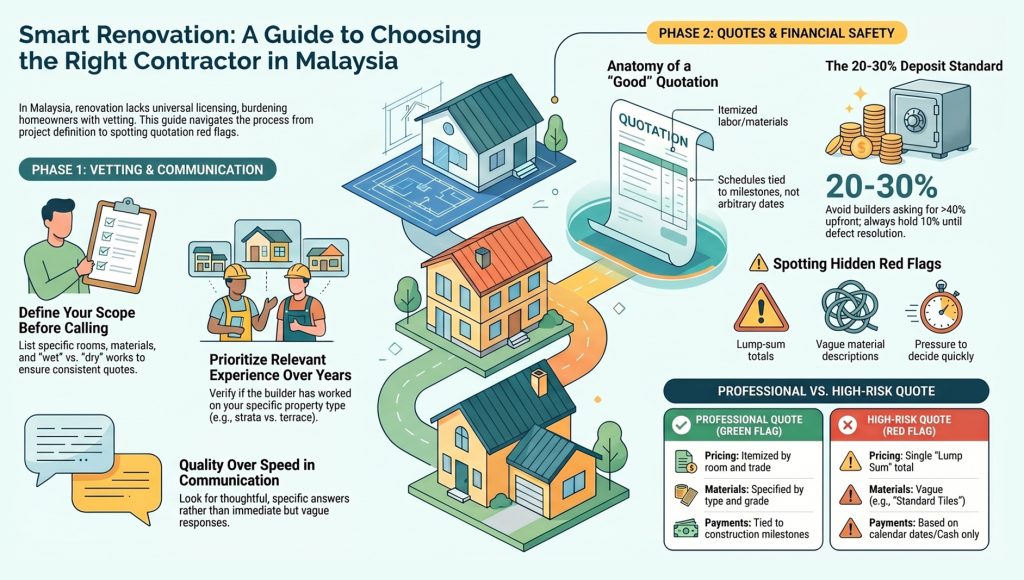
Write down the rooms involved, the type of work in each room, any materials or finishes you already have in mind, and whether you are working with a fixed budget or an open one. Note whether you need wet works like tiling, hacking, and plumbing, or mainly dry works like carpentry, painting, and flooring. These are very different skill sets and not every builder is equally strong at both.
Having a written brief, even a rough one, also signals to prospective builders that you are a serious client who has thought the project through. Builders who frequently deal with well-prepared homeowners tend to provide more detailed, accurate quotes in return.
Questions worth answering before your first call
- Which rooms are involved and what specifically needs to change in each?
- Is this primarily cosmetic work, functional work, or both?
- Do you need structural changes such as hacking walls or relocating plumbing?
- What is your maximum budget, and where are you flexible?
- What is your expected timeline and move-in date?
3. How to Assess Experience: What to Ask and What to Look For
Years in business is a starting point, not a verdict. What matters more is whether a builder has handled projects genuinely similar to yours, on property types like yours, at a scale close to yours.
A specialist who has spent the last five years doing office fit-outs in KL city may not be the right choice for a full renovation of a 30-year-old double-storey terrace house in Cheras. The site conditions, common defect types, and coordination requirements are quite different. Ask directly: have you worked on this type of property before? Have you dealt with older terrace houses, or mainly newer condos?
When reviewing past work, do not just look at photos of finished spaces. Anyone can photograph a nice-looking room. Ask the builder to walk you through a specific past project: what was the original condition, what complications came up, and how did they handle them. A builder who can answer that question in concrete, practical terms has almost certainly done the work themselves. One who speaks only in generalities probably has not.
If possible, ask for contact details of a past client whose project was similar to yours and reach out directly. Most homeowners who had a positive experience are happy to share it. Those five minutes of conversation will tell you more than any portfolio photo.

4. Reading a Quotation: What Good Looks Like
Get at least three itemised quotes before making any decision. Not to find the lowest price, but to understand what the market looks like and to identify what each builder is actually proposing.
A quotation that runs to one page with a lump-sum total tells you almost nothing. A properly prepared quote breaks down labour and materials separately, specifies the type and grade of materials where relevant, lists each scope item by room or trade, and sets out a payment schedule tied to project milestones rather than arbitrary dates.
Pay particular attention to what is not in the quote. Debris removal, protective covering of existing furniture, permit or management deposit fees, and touch-up work after defect inspection are commonly left out by builders who want to keep their headline number low. Ask each builder directly: what is excluded from this quote? If they cannot answer that question specifically, the quote is not complete enough to be useful.
Red flags in a renovation quotation
- Lump-sum totals with no breakdown by scope item or material
- No payment schedule or payment terms not tied to milestones
- Unusually low price with no explanation of how it was calculated
- Vague material descriptions such as ‘standard tiles’ or ‘normal cabinet’
- No mention of what happens if variation works are required
5. How a Builder Communicates Tells You More Than the Quote Does
Pay close attention to how a prospective builder communicates during the quoting stage. Response speed matters less than response quality. Someone who replies within an hour with a vague message is less useful than someone who takes a day but comes back with specific, thoughtful answers.
Does the builder ask questions about your project, or do they just send a price? Do they push back on anything that seems impractical, or do they agree with everything you say? A builder who never disagrees with a client during the quoting stage is often one who agrees to things they cannot realistically deliver, then manages expectations once the deposit is paid and work has started.
Watch for builders who become evasive when you ask practical questions: who will be on site daily, how will variation works be priced, what happens if the project runs over schedule. These are basic, reasonable questions. Any experienced, honest builder will answer them without hesitation. Reluctance or vagueness at this stage is a warning sign, not a quirk.
6. Practical Questions to Ask Before You Sign Anything
Most renovation disputes in Malaysia trace back to things that were never discussed clearly before work started. Asking the right questions upfront costs nothing and protects both sides.
Ask about the team and site supervision
Who will be on site every day? Is it the person you are speaking to, or will work be delegated to subcontractors you have never met? For larger projects, find out whether there is a dedicated site supervisor and how often the principal builder visits. Renovation quality often comes down to consistent supervision, not just the skill of the individual workers.
Ask about variation works and cost changes
What is the process if something unexpected comes up once work starts, like discovering damaged pipes behind a wall or rotten floor joists under old tiles? How are extra costs calculated and approved? A reputable builder will have a standard process for this: written variation orders with a cost estimate that requires your sign-off before any extra work proceeds. If the answer is vague, that is a problem.
Ask about the payment structure
Standard practice in Malaysia involves a deposit of between 20 and 30 percent upfront, with progress payments tied to specific milestones, and a final payment of 10 percent held until the defect inspection is completed and outstanding items are resolved. Be cautious of any builder asking for more than 40 percent before work has started. That payment structure puts significant leverage in their hands before you have seen a single thing delivered.
Ask about approvals and permits
If you are renovating in a strata development, whether a condo in Bangsar, a serviced apartment in Damansara, or a townhouse in Puchong, your Joint Management Body or Management Corporation will almost certainly require a renovation permit, a refundable deposit, and registration of the workers before access is granted. Ask the builder whether they are familiar with this process and whether they will handle it or expect you to. Builders who have worked on strata properties before will know exactly what is required.
7. Warning Signs That Are Easy to Miss
Some red flags only become visible once you know what to look for. Pressure to decide quickly is one of the most common. A builder who tells you the price is only valid for a few days, or who implies other clients are waiting to take your slot, is using a sales tactic, not giving you genuine market information.
Requests for large cash payments without proper receipts, reluctance to provide a written contract, and difficulty providing references from recent clients are all serious warning signs. So is a builder who is consistently unreachable after the first few conversations, or who turns up late to site visits without acknowledgement.
One of the more costly traps in Malaysia is the low initial quote followed by frequent variation orders once work is underway. The original quote wins the job; the variations are where the margin is made. Protecting yourself means getting a detailed quote, asking specifically what is excluded, and agreeing upfront on how variations will be handled and priced before you sign.

Bringing It All Together
Choosing the right renovation builder in Malaysia comes down to three things: relevant experience, transparent communication, and a quotation detailed enough to hold both parties accountable.
Price is part of the picture, but it should never be the deciding factor on its own. Two builders quoting RM60,000 and RM38,000 for the same house are not offering the same thing, even if the scope sounds similar. Understanding what each quote actually covers, and what it does not, is where the real comparison happens.
Take the time to ask proper questions, check references, and get everything agreed in writing before work starts. The homeowners who do this consistently are the ones whose renovations finish on time, on budget, and without the kind of disputes that are unfortunately common when corners are cut at the selection stage.
Frequently Asked Questions
How do I know if a renovation builder is reliable?
Ask for references from recent clients with similar projects and follow up on them directly. Review past work photos critically, not just for aesthetics but for finishing quality and consistency. Ask specific questions about how they handled problems on past projects. Reliable builders give detailed, confident answers. Vague or evasive responses at the quoting stage tend to get worse once work starts.
How much deposit should I pay a renovation builder in Malaysia?
Standard practice is 20 to 30 percent upfront, with the balance paid in stages tied to project milestones. A final retention of around 10 percent held until defect checks are completed is also reasonable and worth requesting. Be cautious of any builder asking for more than 40 percent before any work has begun, particularly if no written contract has been provided.
Should I get a written contract for renovation work?
Yes, always. At minimum, a written agreement should cover the full scope of work, materials specified by type and grade, the payment schedule tied to milestones, the expected timeline, how variation works will be handled and priced, and a defect liability period after completion. Verbal agreements are very difficult to enforce if a dispute arises later.
What is the difference between a contractor and a subcontractor?
A main builder takes overall responsibility for your project, coordinates the works, and is your primary point of contact. Subcontractors are specialists brought in for specific trades, such as electricians, plumbers, or tilers. Many builders use subcontractors, which is normal. What matters is whether the main builder takes accountability for the subcontractors’ work quality and attendance, or whether you are effectively managing multiple parties yourself.
Do I need approval before renovation work starts in a condo in Malaysia?
Yes. Most strata developments in Klang Valley require you to submit a renovation form, register workers, pay a refundable deposit to the Joint Management Body or Management Corporation, and agree to specific working hours before any hacking, plumbing, or electrical work can begin. Starting without approval can result in your builders being refused access, fines, or in serious cases, a requirement to restore the unit. Confirm the process with your building management before fixing a start date.